Chlorine-free anti-felting for wool tops, yarn and fabric
Wool felts and shrinks because its surface scales let fibers move one way and lock the other way under heat, water and agitation. For decades the standard answer has been chlorination of the scale layer. It works, but it brings an effluent problem, fiber damage and uneven results that mills and their customers increasingly want to move away from.
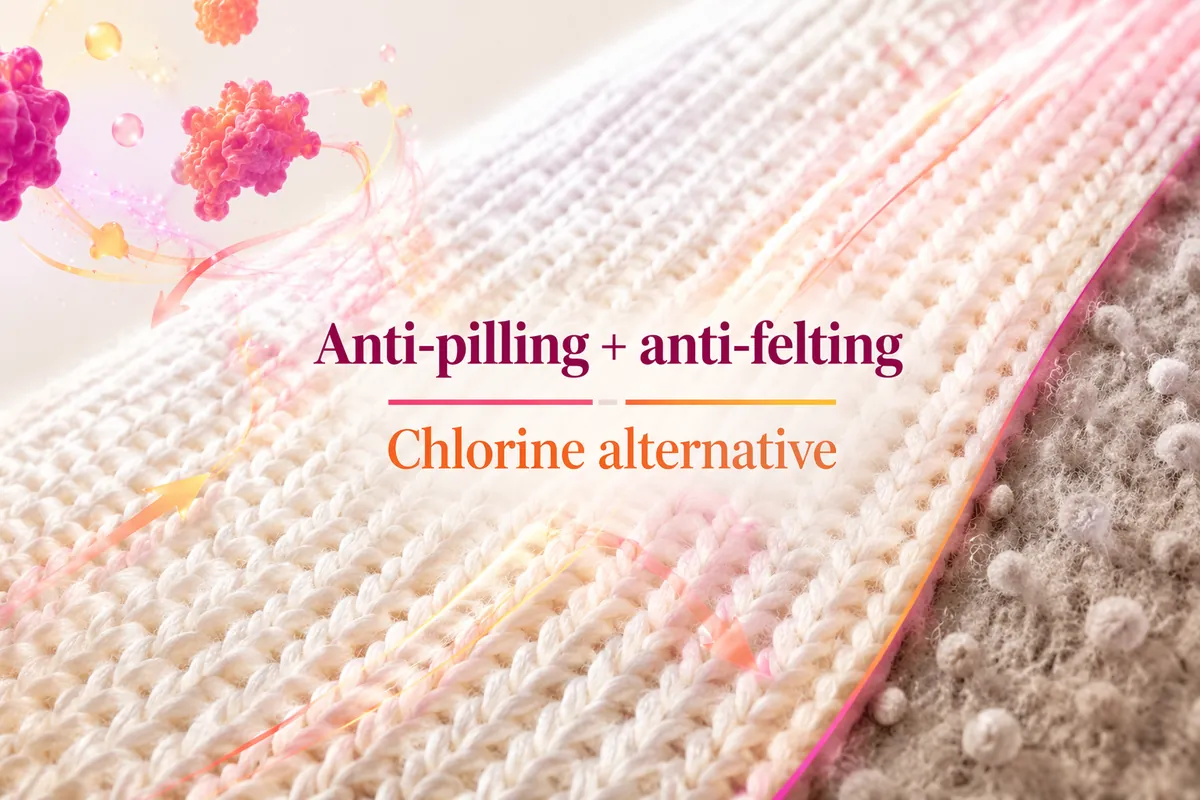
Enzyme anti-felting is the chlorine-free route. Protease and lipase type enzymes work on the wool scale layer and change its structure, so the fiber loses much of its felting tendency without a chlorine step. For wool mills, finishing houses, converters and the textile auxiliary distributors who supply them, the business case is simple: shrink control that customers accept, with less fiber damage, less effluent burden and a more even result across the lot.
Wholesale and bulk supply, by quote. For mills, converters, distributors and resellers: tell us the wool form, the quantity per month or per order, and the destination country. Pack format, price and lead time are quoted per order.
What the enzyme route changes for a mill
Moving anti-felting from chlorine to enzymes is not only an environmental decision. It changes what the mill can promise on the finished article:
- No chlorination effluent. The enzyme route avoids the pollution that comes with chlorine-based anti-felting.
- Dyeability and spinnability kept. Done correctly, the treatment does not hurt how the wool takes dye or how it spins.
- Better pilling resistance. The same surface change that reduces felting also improves the article's resistance to pilling.
- Less fiber damage. The fiber is treated more gently than in an aggressive oxidative route.
- More even shrink-proofing. The treatment is more uniform across the batch, which means fewer lots that pass at one end and fail at the other.
Two places the enzyme step can go
Mills use enzyme anti-felting at one of two points, and the choice decides what you buy and how you run it:
| Process point | What is treated | Why mills choose it | What to watch |
|---|---|---|---|
| Top stage, before dyeing | Wool tops (combed sliver) as a pretreatment | Treats the fiber once, early; every downstream article inherits the shrink resistance | Spinnability and dye uptake must be checked on the treated tops before bulk |
| Fabric, after dyeing | Dyed piece goods or knitwear in the finishing route | Fits mills that buy in tops or yarn and only control the finishing stage | Shade change, strength and handle on the finished article |
Either way, an enzyme activator can be used alongside the enzyme to improve the effect. Ask for the activator and the enzyme together, so the two are matched.
Enzyme route versus chlorination
| Point of comparison | Chlorine-based anti-felting | Enzyme anti-felting (protease and lipase) |
|---|---|---|
| Effluent | Chlorination pollution to manage | Avoids chlorination pollution |
| Fiber damage | Higher risk with aggressive oxidation | Lower fiber damage when the window is controlled |
| Uniformity | Harder to hold even across the batch | More uniform shrink-proofing across the batch |
| Dyeing and spinning | Must be managed around the treatment | Dyeability and spinnability kept |
| Pilling | Not the target of the step | Pilling resistance improves alongside shrink control |
| Where it runs | Usually a dedicated top line | Top stage before dyeing, or fabric after dyeing |
What goes wrong, and how to avoid it
Enzyme anti-felting rewards control and punishes shortcuts. The failures mills report most often:
- Over-treatment. A protease that is left to work too long, too warm or with too much agitation does not stop at the scale layer. The fabric gets thinner, weaker and loses its handle. Define the stop point (rinse, pH shift or temperature change) before the first bulk lot.
- Treating the wrong stage. Running the enzyme on fabric when the shrink problem is built in at the top or yarn stage gives a partial result. Decide where the felting risk enters your route first.
- Skipping the activator check. Running the enzyme without the matching activator, or with an auxiliary package it was not tested with, gives weaker and less even results.
- Judging by touch only. A lot can feel good off the machine and still fail the wash test. Release on dimensional change after the agreed care test, not on handle alone.
- No dye or spin check. Treated tops must be checked for dye uptake and spinning behavior before the whole campaign is treated.
- Lot drift. Changing bath loading, water or machine action between trial and bulk changes the enzyme result. Freeze the recipe once the trial passes.
Where protease fits beyond anti-felting
The same controlled surface work is used for handle and surface clean-up on wool, not only shrink control. Typical uses we quote for:
- Fine wool fabric finishing: premium worsted or wool-rich fabrics where the target is a cleaner touch and controlled drape, not aggressive fiber removal
- Knitwear and wool-rich blends: balancing softness, dimensional stability and surface appearance
- Pre-finish surface preparation: treating before softening or final finishing so the later step is more reproducible
- Shrink-control support: a controlled fiber-surface contribution so the mill relies less on stronger chemical or mechanical steps
What a good trial looks like
Compare treated and untreated goods under the same finishing route, then review:
- Dimensional change after the relevant wash or care test
- Pilling, fuzz or surface change after mechanical handling
- Handle and surface feel after full finishing
- Shade movement against the approved standard
- Fiber strength and fabric integrity
- Dye uptake and spinning behavior, if the tops were treated
- Rinse performance and downstream bath cleanliness
- Reproducibility across repeat trial lots
The decision should be based on the finished article, not only the enzyme bath.
Request a quote for your wool anti-felting program
Wholesale and bulk supply is quoted per order: pack format, price and lead time depend on product, quantity and destination. We supply mills running their own lines and distributors and resellers who supply mills. Please send:
- Product or problem: enzyme anti-felting, protease for handle or surface work, or the activator you need matched
- Wool form and stage: tops before dyeing, yarn, piece goods or knitwear after dyeing
- Quantity: per month or per order, and whether it is for your own line or for resale
- Destination: the country and site the goods ship to
- Process details: current anti-felting route, bath conditions, machine type, and limits on shade, strength or weight loss


